







 |












May God hold us firmly in His service in the midst of this fallen world!
 Jenny, Mary, and Carla at Spanky's in Chapel Hill
 Brian and Mary at Spanky's
 Mary and Jenny at Duke Gardens
 Mary at Duke Gardens
 Carla and Jenny at Duke
 Mary and Jenny at Duke
 Carla stops to smell the lilies!
 Carla, Mary and Jenny at Mary's baby shower
Pregnant Mary at Duke Gardens

Jenny and Carla at Rudino's right before Brian locked Jenny out of the car. See Jenny's June 21st post for more details... http://www.xanga.com/home.aspx?user=jennyzichi

Aunt Anne, Jenny, and mom at Mary's baby shower.

Here is, perhaps, one of the most beautiful personifications in all of the Bible. It's not unlike the quote from my last post (Job 38) where the starry host is depicted as singing for joy at the creation of the world.The heavens declare the glory of God;
the skies proclaim the work of his hands.Day after day they pour forth speech;
night after night they display knowledge.There is no speech or language
where their voice is not heard.Their voice goes out into all the earth,
their words to the ends of the world.(Psalm 19:1-4)
In this passage, Paul argues from Psalm 19, that all the world has heard the message of the universe. There is no one that has failed to hear the witness of the universe.But I ask: Did they not hear? Of course they did: "Their voice has gone out into all the earth, their words to the ends of the world."
(Romans 10:18)
This is very powerful imagery, and somehow it resonates with me deeply. As I read it, I can imagine all of the universe just quivering with excitement that God's plan of redemption is unfolding as Jesus rides to Jerusalem. What God asks of the stones seems too much -- he asks them to hold their peace, to refrain from shouting out in their exuberant joy. It seems an impossible task, because the stones, along with the rest of creation, are panting for redemption. If the people don't praise Jesus, they won't be able to take it anymore. They must cry out -- someone has to! It is too precious a thing to be taken for granted. It must be known and proclaimed.As he went along, people spread their cloaks on the road. When he came near the place where the road goes down the Mount of Olives, the whole crowd of disciples began joyfully to praise God in loud voices for all the miracles they had seen: "Blessed is the king who comes in the name of the Lord!"
Some of the Pharisees in the crowd said to Jesus, "Teacher, rebuke your disciples!"
"I tell you," he replied, "if they keep quiet, the stones will cry out."
(Luke 19:36-40)
Here, the personification works in the reverse. Modern readers might prefer the passage to read the other way around: "We wait eagerly for our redemption, and the universe also waits for its redemption." If we were simply projecting our experience onto the world around us, we should expect the passage to read that way. But, no, the passage is reversed: "The universe has been waiting for its redemption, and so are we."I consider that our present sufferings are not worth comparing with the glory that will be revealed in us.
The creation waits in eager expectation for the sons of God to be revealed. For the creation was subjected to frustration, not by its own choice, but by the will of the one who subjected it, in hope that the creation itself will be liberated from its bondage to decay and brought into the glorious freedom of the children of God. We know that the whole creation has been groaning as in the pains of childbirth right up to the present time.
Not only so, but we ourselves, who have the firstfruits of the Spirit, groan inwardly as we wait eagerly for our adoption as sons, the redemption of our bodies.
(Romans 8:18-23)
Then the LORD answered Job out of the storm. He said: "Who is this that darkens my counsel with words without knowledge? Brace yourself like a man; I will question you, and you shall answer me. Where were you when I laid the earth's foundation? Tell me, if you understand. Who marked off its dimensions? Surely you know! Who stretched a measuring line across it? On what were its footings set, or who laid its cornerstone -- while the morning stars sang together and all the angels shouted for joy? Who shut up the sea behind doors when it burst forth from the womb, when I made the clouds its garment and wrapped it in thick darkness, when I fixed limits for it and set its doors and bars in place, when I said, 'This far you may come and no farther; here is where your proud waves halt'"(Job 38:1-11)
Ever since I read "Surprised by Joy" (C.S. Lewis) last year, I've been fascinated by the device of personification.
In high school English class, we all learned that personification is a "literary device" whereby the author attributes human qualities to something inanimate or non-human.
For example: "The clouds breathed a sigh of relief after the heavy rain." The personification, in this case, gives the clouds a personality -- it brings us beyond the objective fact (i.e. the clouds no longer hold the density of water that they previously did) and into a world where clouds have thoughts and feelings. The personification helps us visualize the clouds reacting the way we might react in a similar situation. That is, if we were clouds, we might feel happy after a heavy rain. We can all relate, of course. When my bladder is full, I'm quite relieved and happy to empty it.
As a literary device, personification can be very, very effective. And I can't help but wonder -- why? Why do we, as human beings, feel the need to project our own experience of the world onto our surroundings? Does it help us make sense out of it all?
(If I were a psychologist, by the way, I think it would be an interesting study to undertake. What areas of the brain are stimulated by personification? What other experiences stimulate those same areas? My hypothesis is that it would stimulate the same pleasure centers that are active when someone figures out a puzzle, makes a connection, or otherwise makes sense out of something that didn't make sense beforehand. The brain loves to understand and make sense out of the world, and it has a tendency to "reward" itself when a connection is made.)
It's a deceptively complex question. Why do we find it pleasurable and sensible to project human qualities onto the world around us?
My simple answer: Personification is much, much more than a mere literary device. It's something that corresponds deeply to the way we understand the world. Personification happens in our deepest parts, in our souls. There's a "truth" in personification that runs against the stream of scientism in our society. In fact, the personification is often much more true than the counterpart scientific statement.
For example, which of the following statements is more true?
(a) The sea is calm tonight.
(b) The tidal waves are 30% smaller tonight than the average of historical measurements.
(check one)
Our society has sold us a lie. What lie? The lie that everything boils down to matter and energy. After all, that's what Einstein's general relativity tells us, right? Anybody remember "e = mc^2" from physics class?) EVERYTHING is essentially particles and energy. That includes the sun, the moon, the grass, you, me, everything. We are little more than walking solar systems -- my body is a big collection of cells in orbit, interacting with each other in complex ways to give the illusion of meaning and intelligence.
Why do we rebel? Why do we insist on drawing connections between the conscious and the unconscious? Why do we refuse to live in a world that is governed strictly by physical interactions?
Surprisingly, this very question enraptured C.S. Lewis. In fact, it was one of the strongest factors in his conversion to Christianity. (To understand fully, you would have to read "Surprised by Joy".) Lewis was drawn to fantasy literature -- mythology, fairy stories, Norse folk-legends. One day he picked up a book called "Phantastes" by George MacDonald. Later, he wrote this:
It must be more than thirty years ago that I bought... Phantastes. A few hours later I knew that I had crossed a great frontier. I had already been waist deep in Romanticism, and likely enough, at any moment, to flounder into its darker and more evil forms, slithering down the steep descent that leads from the love of strangeness to that of eccentricity and thence to that of perversity... What it actually did to me was to convert, even to baptise (that was where the Death came in) my imagination. It did nothing to my intellect nor (at that time) to my conscience... the quality which had enchanted me in his imaginative works turned out to be the quality of the real universe, the divine, magical, terrifying and ecstatic reality in which we all live."C.S.Lewis had found a secret. The universe is alive.(foreword by C. S. Lewis to Lilith by George MacDonald)
 Mary and Erin picking blueberries- five minutes from our house!! Can't get any better than that.

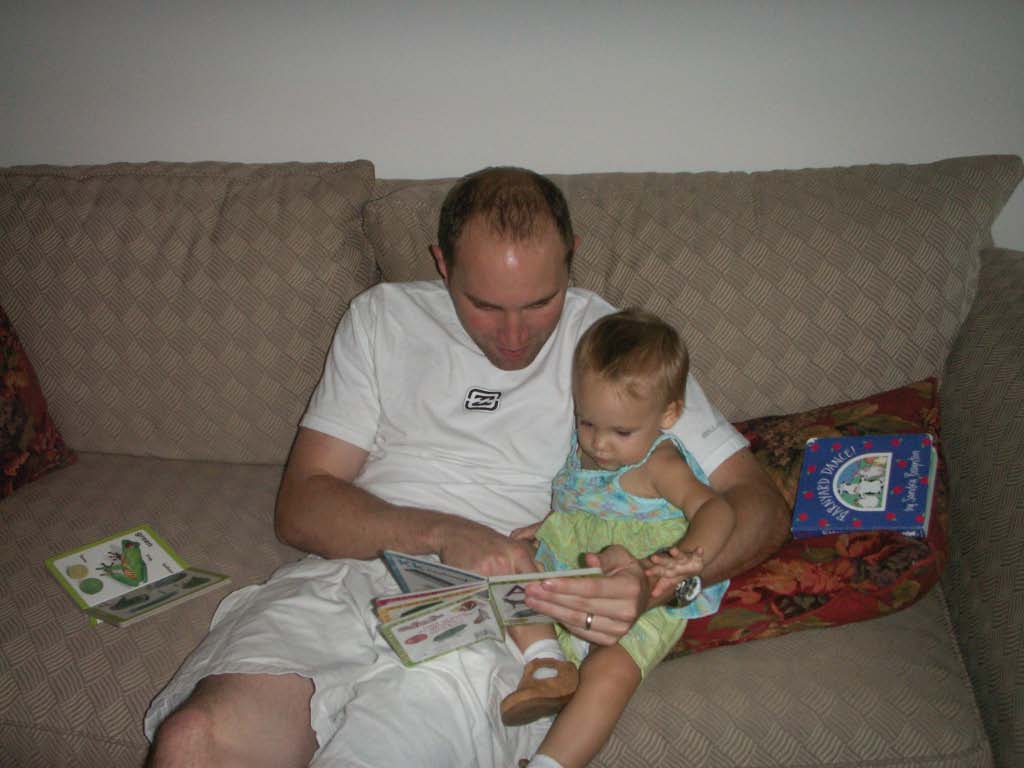
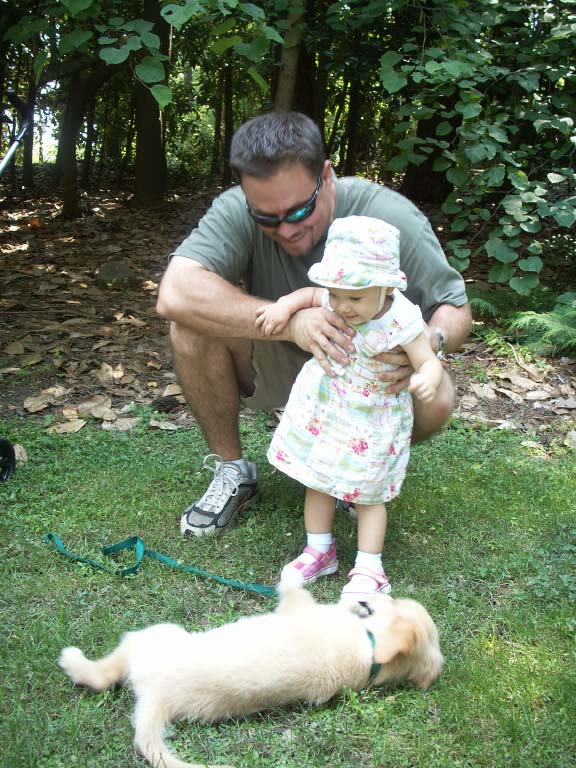
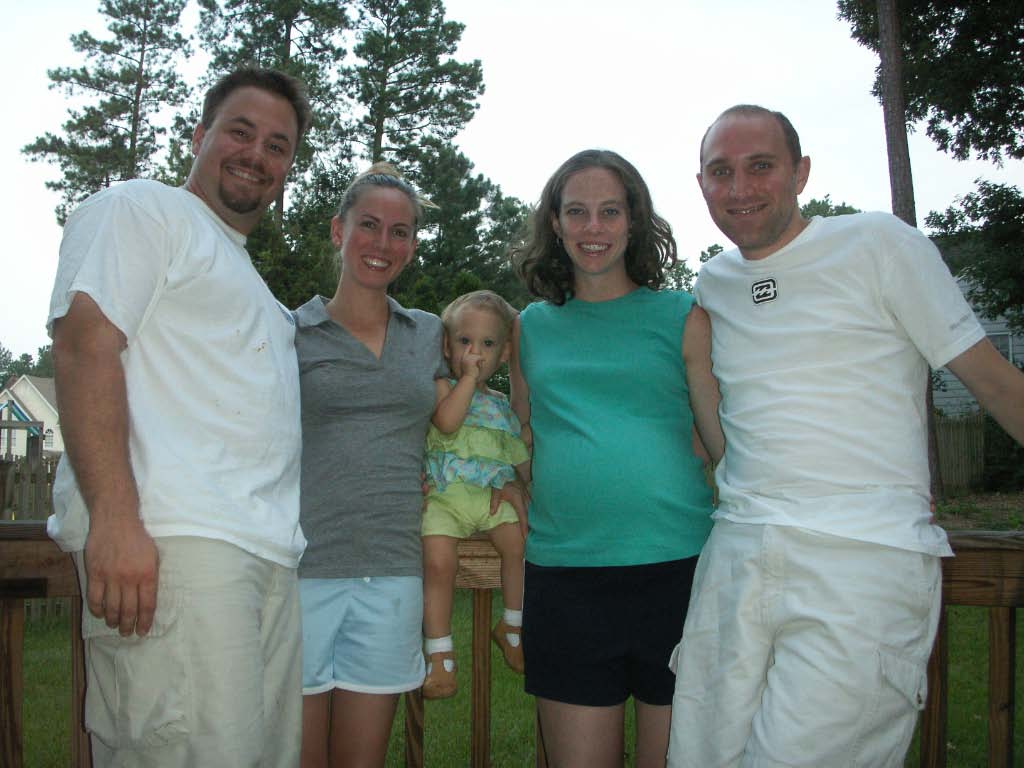
We had a wonderful time with Danielle and Don this weekend. Julia is the cutest thing in the entire world. We went to Duke Gardens/chapel, Mapel View Farms, Fuddruckers, Ruth's Chris (yum) with Danielle's parents, walked around our lake, hung out, and BBQed. What a fun weekend! Now we are off to Waynesville for a short visit with Mary's parents.
